

Guest Post: Where are Europe’s female defence tech leaders?
Data shows only 11.2% of C-level roles in defence tech are occupied by women, writes Benjamin Lussert, Content Strategy Lead for The Big Search
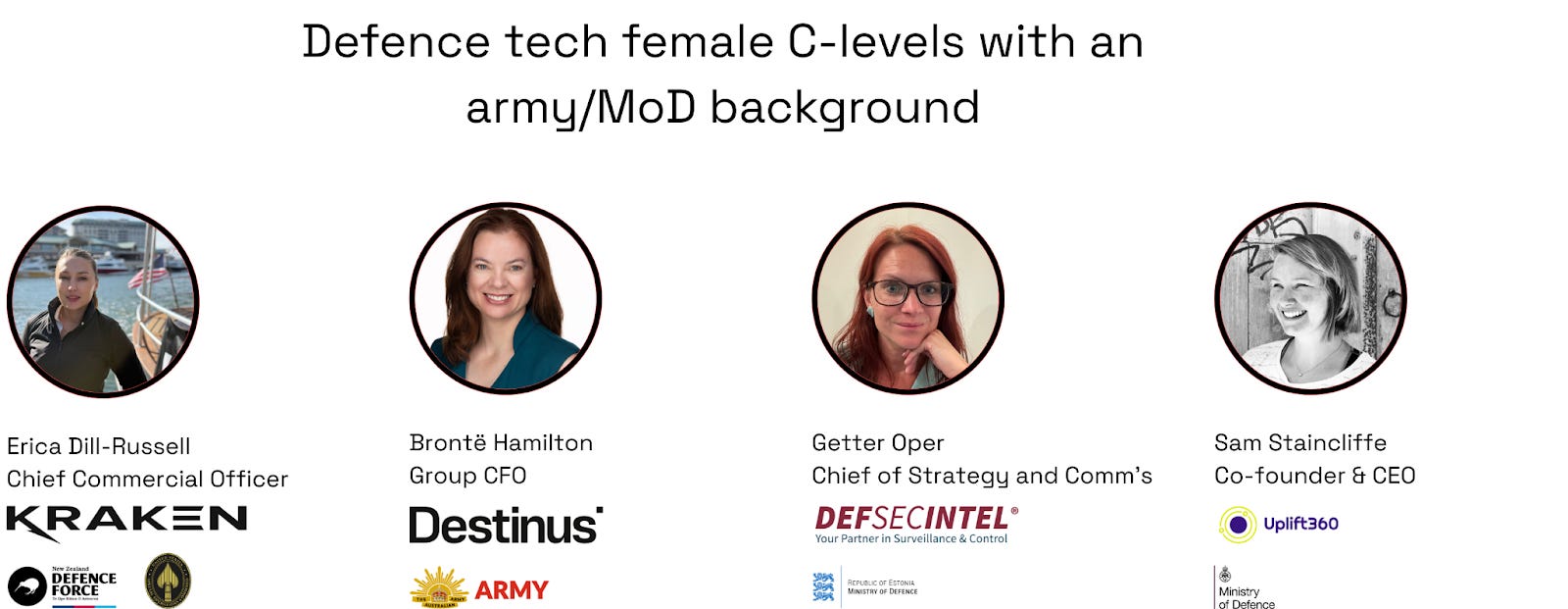
Kraken Technology recently hired Erica Dill-Russell as its new chief commercial officer – a potential “trailblazer“ of a move in the market, given how few women hold C-level roles in the European defence tech space.
But how many women are there actually in European defence tech? That’s what we tried to find out.

Using Dealroom’s European company pool and focusing on defence tech and dual-use startups and scaleups, we identified 1,034 C-levels across 396 companies.
Out of those, we found just 116 women across 95 organisations. That’s 11.2%.
From there, we looked at their locations, the roles they hold, and their military/MoD or defence background.
Where are these defence tech female C-levels located?
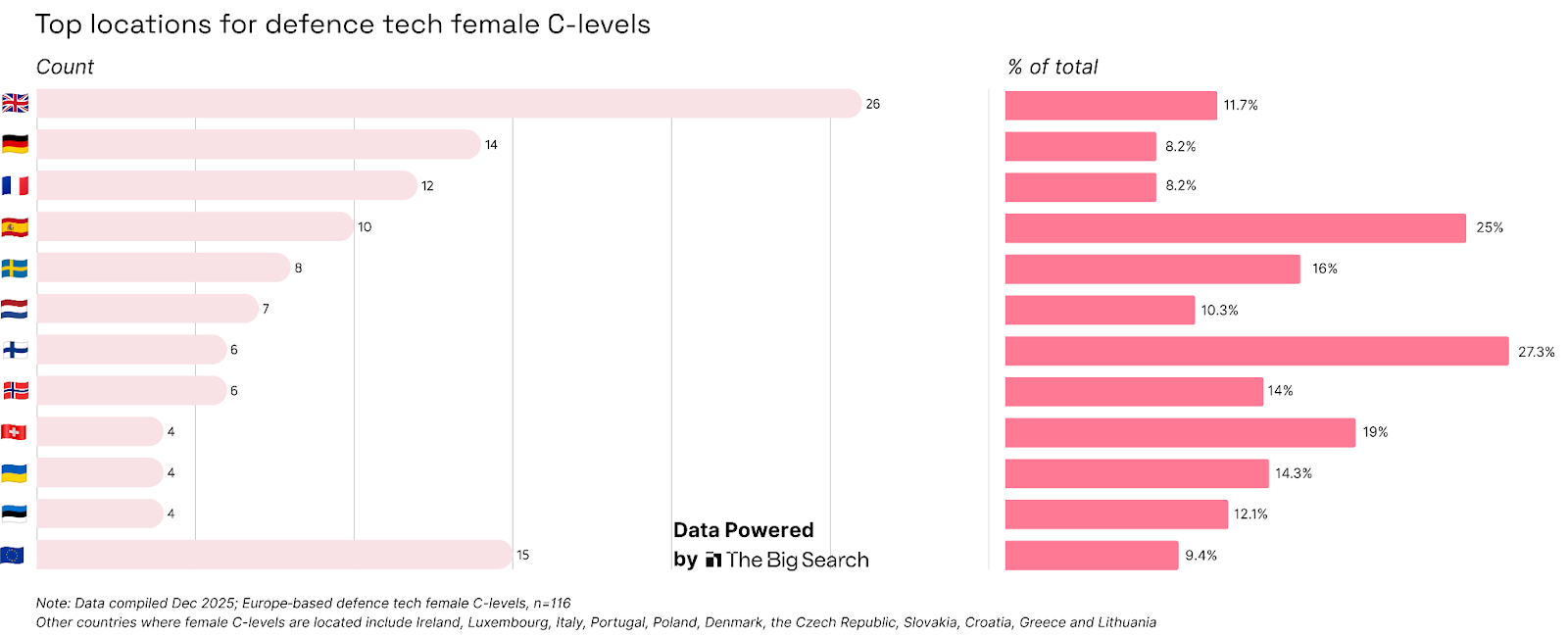
In absolute numbers, it’s no surprise to see defence tech companies from the UK, Germany and France employing the most women.
These countries dominate defence tech funding and invest a large share of their procurement money into domestic companies. With more well-funded firms, you’d naturally expect more structured C-level teams and more women at that level than in other European countries.
But the right side of the graph shows you something else: the share of defence tech female C-levels in each country. While the UK, Germany and France rank low, Finland and Spain stand out with the highest share of women in defence tech leadership. In Spain, notably, the dual-use quantum company Multiverse Computing has three women at C-level:

Which role do they occupy?
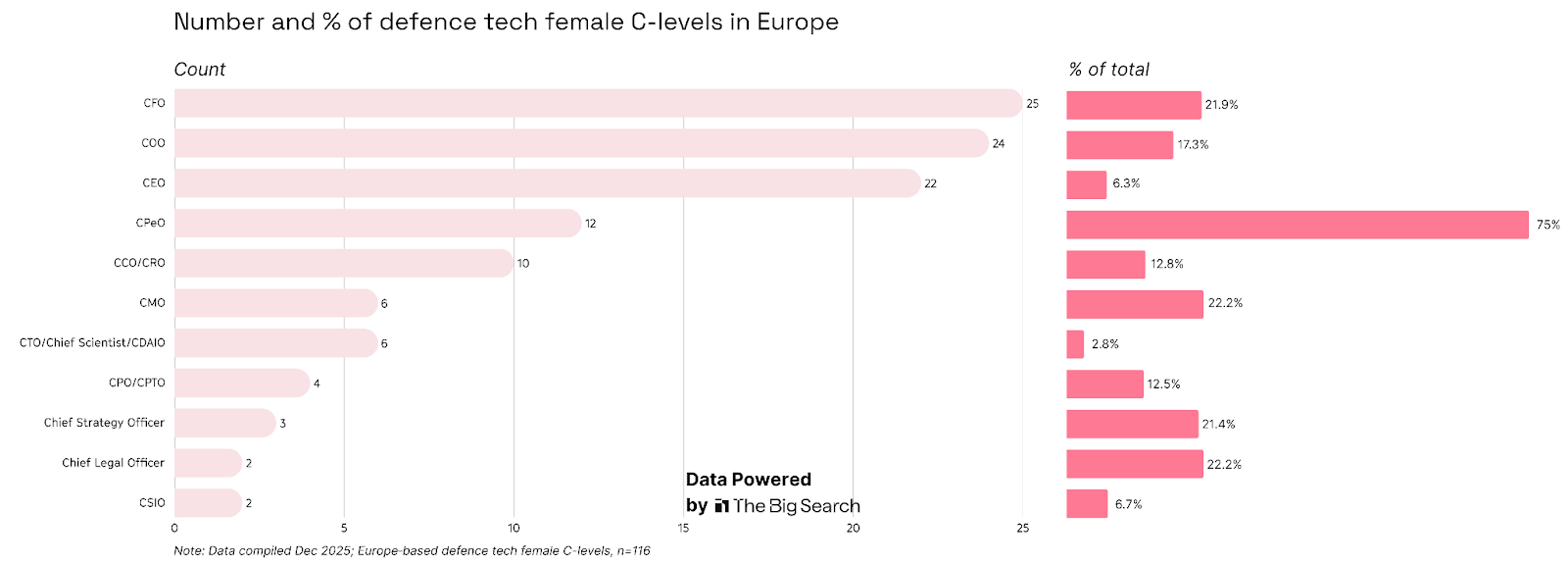
Across defence tech, women at C‑level mostly work in finance and ops when you look at absolute numbers, and in people, marketing and legal when you consider percentages.
It’s interesting to see that even in a niche market like defence tech, those numbers actually reflect broader C-level gender data across the tech industry.
Technology, product and security roles, on the other hand, draw from STEM pipelines where women remain underrepresented. On top of that, these companies work with advanced technologies such as quantum computing, nanotechnologies or advanced robotics, where the share of women can be even smaller. Overall, that leaves us with a very narrow pipeline to begin with.
The glass ceiling remains particularly solid at the very top. Only 6.3% of defence tech CEOs are women. Most of these companies are early‑stage and founder‑led, and founding teams still overwhelmingly come from technical or military/MoD backgrounds that remain male-dominated.
Only a small share has a military/MoD or defence background
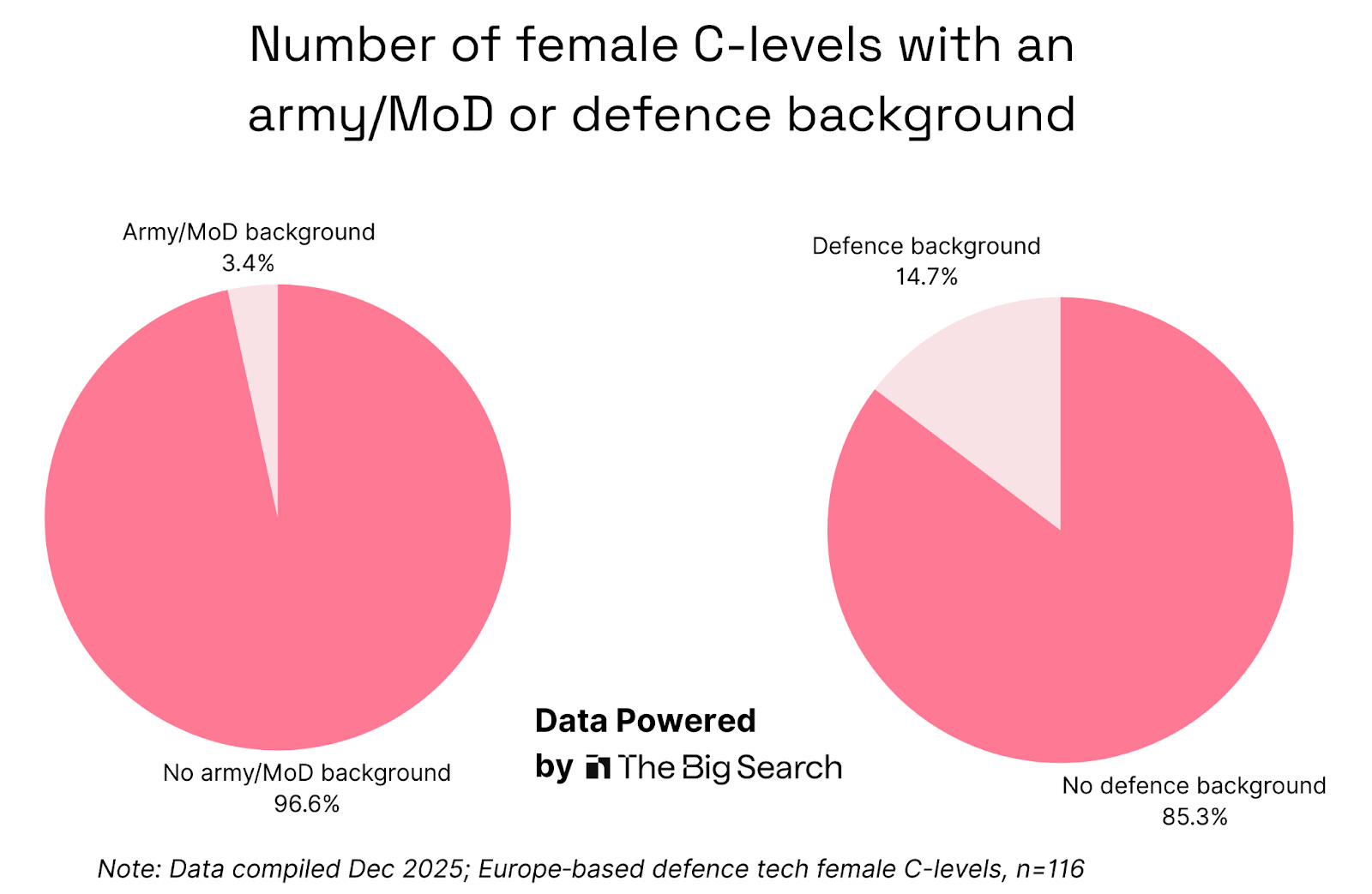
There are fewer C-level leaders with defence backgrounds than you might expect. According to our earlier analysis, 12.7% of defence tech C‑level leaders overall have previous military experience. Nevertheless, the number of women in that category is even smaller: just 3.4% of these female leaders have a military/MoD background.
Part of the explanation sits at the very start of the pipeline. Across the national armed forces of EU NATO members, women make up only 11% of full-time personnel and less than 10% of the highest officer ranks. That already leaves a very small pool of women with military experience who could later move into defence tech.
However, as Yuliya Maltseva, co-founder of Women in Defense Tech, pointed out, many European militaries are now actively recruiting women due to the lack of soldiers and the current geopolitical climate. If you live in the Netherlands, you’ve probably seen the army ads that now prominently feature women. Thus, as more women enter the EU NATO armed forces, that pipeline should widen, and over time, a larger share of them may move into the European defence tech sector.
To date, Europe has only produced a small number of defence tech scaleups. That means the whole sector is still running on a limited pool of C-level leaders with long track records.
Talent from traditional primes is also costly, so only the well-funded neo primes can usually compete for them. Instead, we’ve noticed that early-stage companies are building their own supply of talent and giving leadership opportunities to people who arrive without a classic defence background, including women who come from completely different fields and might not have seen this sector as an option until now.
Benjamin Lussert leads the content strategy at The Big Search, a tech executive search firm, and produces data-driven research pieces about talent and leadership in the tech industry.
 | A guest post by
|