Defence startups that want to increase their chances of winning major government tenders are teaming up with primes. Today, Helsing was the latest development of that trend with a new partnership to expand its space strategy. The German startup has linked up with Kongsberg Defence & Aerospace, the Norwegian prime that makes space software and hardware, among other products, to develop a new AI-based satellite system.
ingThe project does not have a specific customer at this point but it comes at a time when European governments are gearing up to spend money on improving their defence posture above the earth. Helsing, for its part, is now valued at €12 billion, so expect to see it pursuing a lot of different projects and business opportunities as it ramps up its revenues to meet growth projections.
The partnership, announced at an event today in Berlin, coincides with a growing focus on how best to leverage space when building out defence capabilities, intelligence gathering, and communications resilience — three areas that have been highlighted throughout the war in Ukraine, where satellite tech has played a key role on both sides of the conflict.
That is something both Helsing and Kongsberg have seen first-hand as active suppliers to Ukraine’s military.
The two say they plan to develop and deploy a “sovereign, space-based intelligence, surveillance, and targeting (IST) constellation with an interconnected comms layer” for Europe.
Kongsberg will contribute satellite technology; Helsing will contribute “AI-driven software” to improve satellite image analysis using technologies such as synthetic aperture radar (SAR), electro-optical (EO), and radio frequency (RF). A third company, Hensoldt, will contribute sensors for SAR radar, EO/IR (Electro-Optical/Infrared) and EW (Electronic Warfare).
They aim to have this produced by 2029, the companies said.
Although there is no specific contract to which they are working, there is a significant prospect on the horizon.
In November 2025, the German ministries of defence and foreign affairs jointly published a lenthy strategic review laying out the current landscape of geopolitical risks and the need strengthen Germany’s and Europe’s defences high above the earth to help defend it and build more resilience. In all, it has proposed earmarking some €35 billion in coming years to improve satellites, orbital surveillance and military space operations, among other areas.
That focus aligns with how areospace companies see things.
“Sovereign monitoring, intelligence, and targeting are fundamental to credible deterrence,” said Eirik Lie, president of Kongsberg Defence & Aerospace, in a statement. “Communication, oversight and connectivity are key to operate defence assets effectively, and Europe needs full control over these capabilities.”
Helsing is Europe’s largest privately-held defence tech startup, currently valued at €12 billion, and it counts Germany, the UK and France among its customers.
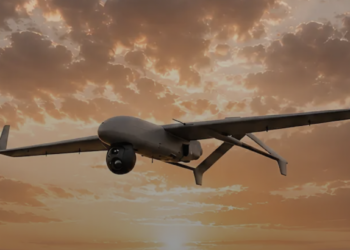
It is best known for its air-based drones, which are actively being used in Ukraine.
But as with other defence tech startups that have raised hundreds of millions in capital, the company has a long way to go to grow into its hefty valuation. And so it has been working to expand what it does, which includes developing technology for other terrains. Last month, we visited the company’s first factory in the UK, in Plymouth, where it is building marine vessels.
And space has been on Helsing’s radar, too, so to speak. In February 2025, it announced a partnership with Loft, the Toulouse, France-founded space startup (which itself has raised hundreds of millions of dollars) to build a Low-Earth-Orbit satellite constellation equipped with Helsing’s AI to track various activity from up high, including border surveillance, troop movements, and critical infrastructure.
Even before that, Helsing identified space some time ago as an area where it had to build more eventually because of how critical it is to data gathering.
“The war in Ukraine demonstrates that most reliable targeting begins in space,” Gundbert Scherf, co-CEO and co-founder of Helsing, said in a statement. “Space-based ISR is the most reliable, all-weather source for persistent intelligence as we have demonstrated with our data analysis algorithms already being used in Ukraine. Together with Kongsberg, we will provide crucial integrated space defence systems to ensure Europe wins the fight for sovereignty.”