

Helsing turns to automaker Schaeffler to scale drones and harden Europe’s supply chains
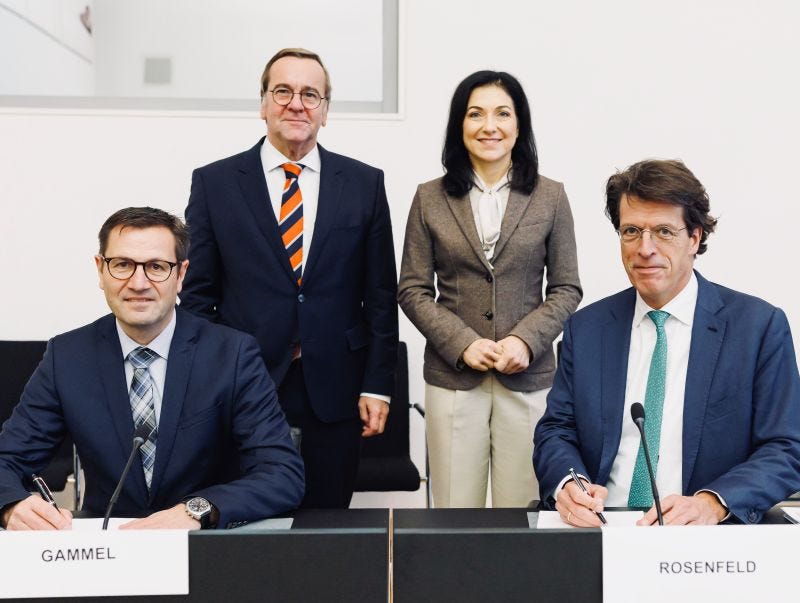
Helsing and automotive supplier Schaeffler have signed a Memorandum of Understanding that pulls one of Germany’s big industrial names deeper into defence. Under the agreement, Schaeffler will take on manufacturing and procurement of key electronic components for Helsing’s drones and work with the company on securing access to critical semiconductors and raw materials.
The MoU was signed in Berlin by Schaeffler CEO Klaus Rosenfeld and Wolfgang Gammel, Managing Director of Helsing Germany, in front of Defence Minister Boris Pistorius and Economic Affairs Minister Katherina Reiche.
German press reports say Helsing plans to lift output to around 10,000 to 20,000 drones per year from 2026, with surge capacity to 100,000 units in a crisis. Production of the airframes and systems will remain with Helsing, while Schaeffler focuses on the electronics and the upstream supply chain for chips and materials. For Schaeffler, this is a concrete first step after months of signalling interest in a larger move into the defence sector.
“German car suppliers can scale like no other industry and quickly support the development of resilient supply chains,” said Helsing. “The cooperation with Schaeffler enables us to produce fast and reliable mass production.”
For Berlin, the optics are deliberate. Pistorius used the signing to make a broader point.
“We need stronger networking between the civil and defence industries. The MoU between Helsing and Schaeffler is an excellent example for many others,” he said.
Helsing and Schaeffler
Helsing is a Munich-based defence technology company founded in 2021 by Torsten Reil, Gundbert Scherf, and Niklas Köhler. It presents itself as an AI-first defence firm that sells only to democratic governments. The company builds software that ingests data from sensors, drones, and legacy platforms and then feeds back real-time targeting and situational awareness to operators.
The firm has attracted large amounts of capital and political backing. Recent funding rounds led by General Catalyst, Saab, and Daniel Ek’s Prima Materia have pushed its valuation into double-digit billions of euros and made it one of Europe’s most closely watched defence startups. That growth has not come without friction. Bloomberg and others have reported concerns about pricing and reliability from some former staff and military experts, and at least one planned tie-up, with Rheinmetall, has collapsed.
Schaeffler is almost the opposite story. It is not a new name in tech circles but a classic German supplier with more than 75 years of history in bearings, powertrain components, and motion systems. The group employs over 80,000 people and has been a core partner to major automakers, winning repeated awards from customers like General Motors.
Like most large suppliers, Schaeffler has been hit by weak automotive demand, trade tensions, and pressure from Chinese competition. In response, it has started to reposition itself as a broader mobility company. That includes investments in electric drivetrains, robotics, and now defence. In June, CEO Klaus Rosenfeld said openly that the group was examining a sizeable move into defence, arguing that its skills in precision manufacturing, materials, and complex mechanical systems fit the needs of land, sea, and air platforms.
Seen from that angle, the Helsing deal is not a political gesture but part of a wider shift. Schaeffler wants to replace shrinking auto margins with business in sectors where scale manufacturing and reliability still matter and where Europe is trying to rebuild capacity.
By putting Schaeffler in charge of key electronic components and upstream procurement, Helsing is plugging into a company that already manages complex supply networks across continents. Schaeffler knows how to dual-source, how to lock in long-term contracts, and how to keep assembly lines running when shipping lanes and tariff schedules change. That is exactly what ministries mean when they talk about “resilient” supply chains, even if the term has become tired from overuse.