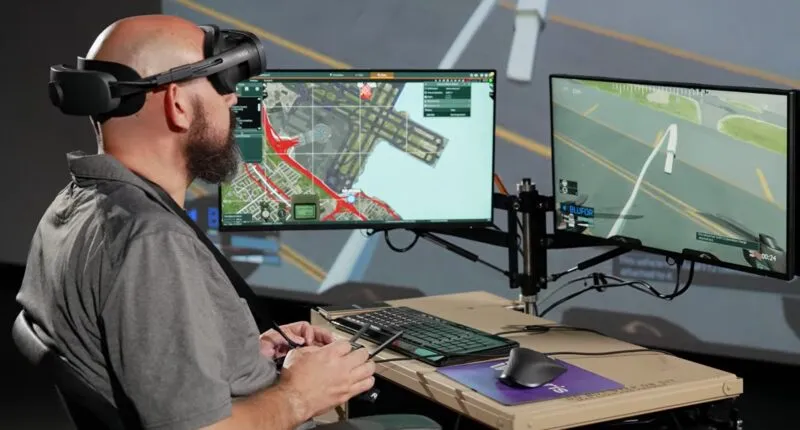
Atlanta-based InVeris has announced fats Drone, a virtual trainer for small unmanned aerial systems. Built on Bohemia Interactive Simulations’ VBS4 platform, the system lets troops fly simulated FPV and other small drones inside a shared digital space allowing them to simulate running reconnaissance and attack runs and practice counter-drone tactics and resupply drops. It’s like a big video game for drone operators who don’t want to risk crashing expensive drones in the field.
Headquartered near Atlanta, the company has spent decades in live-fire and virtual weapons training, and is the small arms trainer program of record for both the US Army and the US Marine Corps. Across defense and public safety markets, it claims more than 5,100 simulation training systems, around 40,000 firearms simulators, and roughly 15,000 live fire ranges in over 40 countries.
The system can run on a standard screen or through a headset that mimics FPV goggles, so an operator trains with something close to the visual tunnel they will face in the field. InVeris has limited fats Drone to collective training, which fits how drones are actually used in combat. Operators, squad leaders, and air defense teams can work inside the same scenario, practicing how they pass targets, manage airspace, and respond when the other side is flying cheap quadcopters of their own.
As InVeris product manager Michael Brazell points out, a trainee learning to fly will usually crash and destroy at least one drone, with each airframe running roughly $1,000 to $2,000 USD.
“Scaling to train 10,000 troops to fly without a simulator could cost millions of dollars and dry up critical supply lines,” said Brazell. “Simulation removes the recurring cost of buying physical drones, and there is no financial or logistical burden when a trainee crashes a drone in the simulator.”
The point, he said, is not only to save money, but to protect supply so operational units are not stripped of drones so that new pilots can learn to fly them.
The US Army is in the middle of a five-year, 36-billion-dollar reorganisation that aims to equip each of its ten combat divisions with roughly a thousand drones plus counter-drone systems, while retiring older platforms like Humvees, light tanks, and early Apache models. If even a fraction of those new drones are FPV or loitering systems, writes InVeris, the training requirement is enormous.
This is part of a wider move in industry toward specialised drone training. Other vendors are tying VR and mixed-reality headsets to front line experience so that students train against realistic tactics and threat profiles. National Defense has already flagged a wave of companies building drone training ecosystems around platforms like VBS4, with different firms contributing flight models, mission data, and courseware.