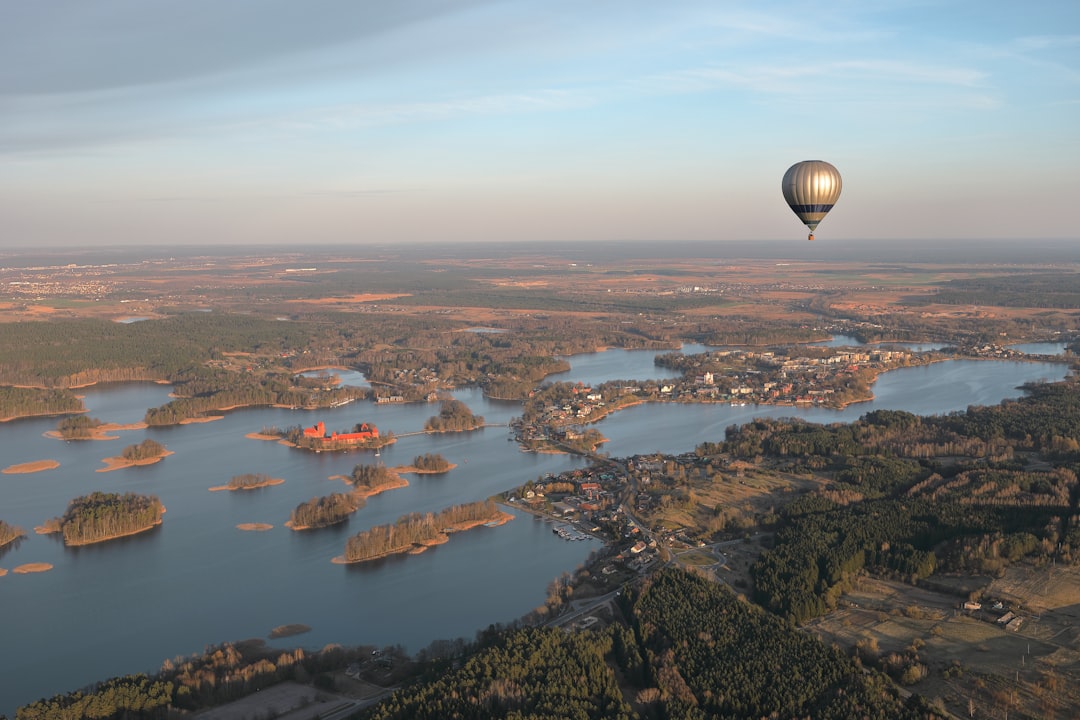
The Lithuanian government declared a national state of emergency on Tuesday in response to a sharp increase in balloon and drone incursions from Belarus, to the tune of more than two incursions per day. The declaration potentially gives the military a hand in managing the situation alongside the country’s ministry of the interior, underscoring rising geopolitical tensions across the region.
Up to now, the majority of the airborne devices appear to have carried no more than contraband cigarettes, but their significance goes beyond tax avoidance. The set-up has wreaked havoc on air traffic, and it potentially paves the way to send more dangerous and nefarious items over the border.
Lithuanian Prime Minister Inga Rugienenė, European Commission President Ursula von der Leyen, and others have gone so far as to start describing the incursions a form of “hybrid attack.”
In this year alone, over 600 balloons and 200 drones have been launched from the Belarus border so far, causing Vilnius International Airport to close and divert more than 300 flights. It was this plus the larger security implications that led to the state of emergency, said officials.
“The emergency was declared because of disruptions to civil aviation and because of national security concerns,” said Interior Minister Vladislavas Kondratovičius.
On the heels of the declaration, the government has now submitted a request to the Saeimas (parliament) to allow the military to join efforts in addressing the incursions.
In the Baltic state, border issues are under the jurisdiction of the Ministry of the Interior, which does not have a mandate for military intervention. According to Reuters, if the government gets the nod on the request, the army would be able to limit access to a territory; to stop and search vehicles; to perform checks on people, their documents and their belongings; and to detain those resisting or suspected of crimes.
The state of emergency is a dramatic but unsurprising start for Minister for Defence, Robertas Kaunas.
When he was appointed to the role less than 30 days ago, it came amidst a moment of political turmoil – the current Prime Minister came to power at the end of September after a vote of no-confidence in the previous government. Alongside that, the situation with the balloons and drones was well-known, with politicians and others already beating the drum for a stronger response. Declaring a state of emergency to get the military involved, therefore, is a signal from the government that it’s taking the situation seriously and will respond accordingly.
Yet it’s also being done in concert with wider authorities. The government reportedly consulted both with EU and NATO officials before making the call.
The balloons carrying contraband cigarettes each have a weight capacity of 50kg, and the government has described their presence as a “deliberate act of disruption” on the part of Moscow-influenced Belarus.
In a previous conversation with Resilience Media, defence tech investor and advisor Rokas Tamošiūnas pointed out that while the balloons are currently carrying cigarettes, the concern is that they could be swapped out for a more sinister payload.
Several countries across Europe have seen a rise in drone and balloon incursions, particularly in the wake of Russia’s invasion of Ukraine and escalating tensions in the region. In addition to Lithuania, drones and balloons have been spotted in countries that share a border with Russia and its allies such as Poland, Latvia, Estonia, and Finland; as well as in European countries beyond that periphery, including Belgium, Norway and Germany.
Yet to date, Lithuania is the only EU or NATO country to have declared a state of emergency over the balloon and drone incursions.
Part of the reason may be due to the sheer number of disruptions in Lithuania’s airspace. The combined number of drones and balloons totals more than 800 so far for 2025. That works out to more than two per day on average.
We have reached out to Lithuania’s Ministry of Defence for more comment on what comes next. So far, it has referred our questions to the Ministry of the Interior.
One small silver lining for the technology community in all this is that the airspace disruptions have prompted the MoD to call for innovative proposals to combat the balloon incursions. A total of €1M was made available for businesses to propose and prototype solutions. Currently, no solution yet has been made public.
Resilience Media will update this story as we learn more.