Tuesday 3 March, 2026
[email protected]
Resilience Media
  • About
  • News
  • Resilience Conference
    • Resilience Conference Warsaw 2026
    • Resilience Conference Copenhagen 2026
    • Resilience Conference London 2026
  • Guest Posts
    • Author a Post
  • Subscribe
No Result
View All Result
  • About
  • News
  • Resilience Conference
    • Resilience Conference Warsaw 2026
    • Resilience Conference Copenhagen 2026
    • Resilience Conference London 2026
  • Guest Posts
    • Author a Post
  • Subscribe
No Result
View All Result
Resilience Media
No Result
View All Result

Skyrora secures UK rocket launch licence, marking a first for British spaceflight

Scottish startup could be the first to manufacture and launch a rocket into space entirely from home soil

Paul SawersbyPaul Sawers
August 5, 2025
in Startups, Venture
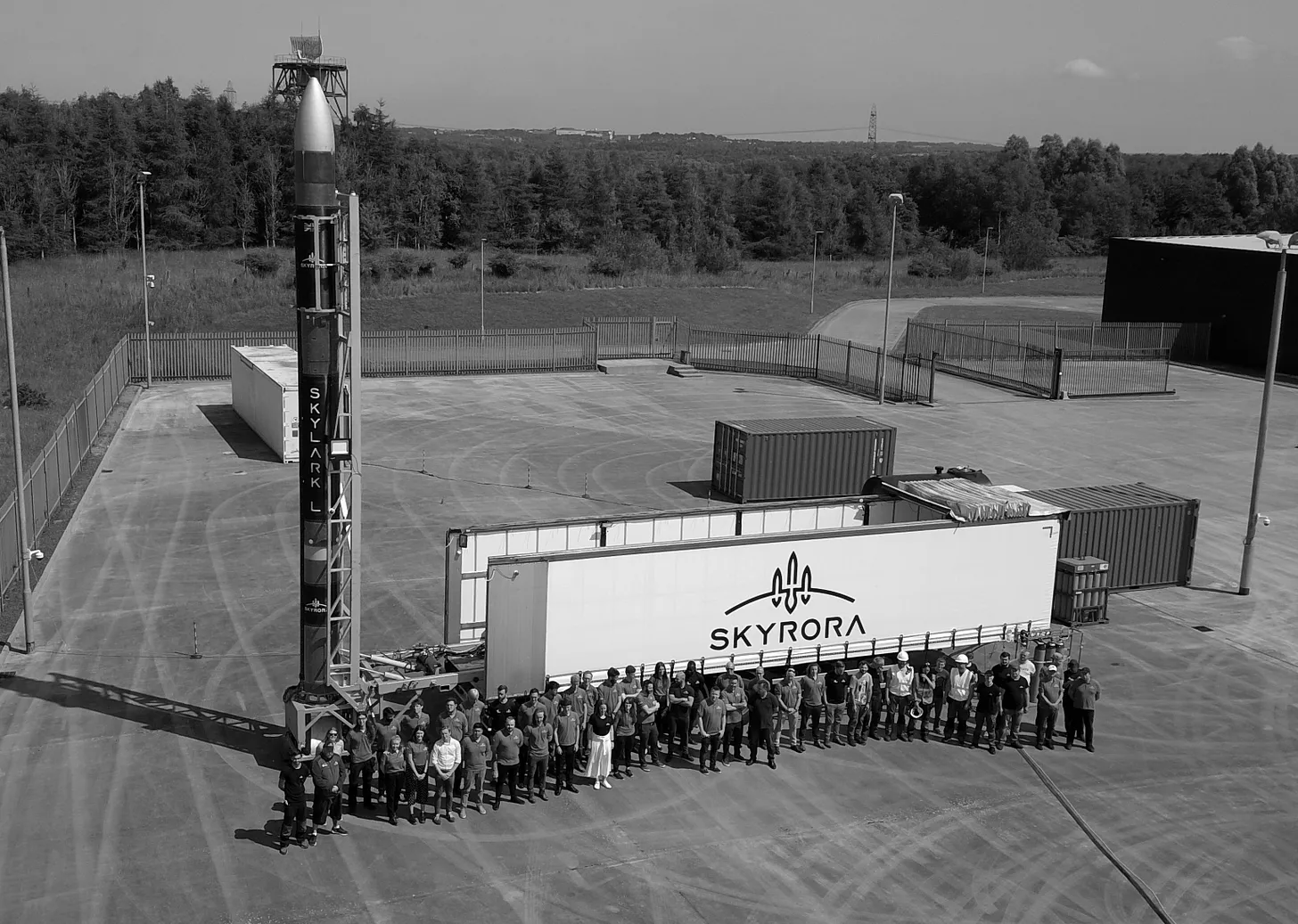
Skyrora team photo with Skylark L rocket

Skyrora team photo with Skylark L rocket

Share on Linkedin

The UK Civil Aviation Authority (CAA) has granted Skyrora a launch operator licence, paving the way for the UK aerospace startup to become the first British company not only to acquire a spaceflight licence, but also to manufacture and launch a rocket into space entirely from home soil.

You Might Also Like

Auterion, the drone software startup, eyes raising $200M at a $1.2B+ valuation

Poland-based FlyFocus raises €4.5 million to build European UAVs

Frankenburg confirms €30M funding to build more EU-made rockets

The announcement also comes as Europe seeks greater technological sovereignty, and steps up its defence efforts to counter rising geopolitical tensions.

“This launch licence isn’t just one giant leap for Skyrora — it’s a massive boost to the whole of Scotland and the wider UK’s space sector,” Scottish Secretary Ian Murray said in a statement. “Becoming the first British company to manufacture and send a rocket into space from the UK will be a hugely significant moment.”

Founded out of Scotland in 2017, Skyrora is the handiwork of CEO and founder Volodymyr Levykin, a Ukrainian-born entrepreneur based in Edinburgh. The company has initiated several test launches through the years, including what was dubbed the “first commercial rocket” test launch from Scotland back in 2018 when Skyrora sent its short-range Skylark Nano vehicle from a site in the Scottish Highlands to an altitude of 6km.

But to carry-out full-scale space missions, especially those aiming for orbit with full payloads, companies need special regulatory approval, which is where Skyrora’s newly-acquired licence comes into play.

Skyrora’s planned launchpad is SaxaVord, a private spaceport on the Shetland Islands that’s licensed for vertical orbital launches. While its own licence means that Skyrora is now able to pursue full-scale operations from UK soil, including higher-altitude sub-orbital missions, the company said that limited launchpad availability will likely delay its first mission to 2026.

“Earlier in the year we were told that there was no longer availability to launch from either of the pads at SaxaVord,” Alan Thompson, head of government affairs at Skyrora, told Resilience Media. “Therefore, despite having a vehicle ready and a launch license, it is unlikely that Skyrora will be able to complete its launch from the UK this year. Skyrora is ready to complete a launch from the first available launch pad next year.”

Thompson added that the company does have an initial payload confirmed for its inaugural sub-orbital launch, but it’s unable to reveal details at present.

Rocket science

Skylark L rocket

Skyrora has developed several rockets and launch vehicles through the years. This includes the Skylark L, which is designed as a developmental vehicle to test subsystems prior to going into the full-scale Skyrora XL – its flagship orbital vehicle which has a target launch date of 2027.

In developing the “prototype” Skylark L vehicle, however, the company may have created a new market for sub-orbital missions such as microgravity science experiments – if the demand is there, that is.

“Skyrora’s strategic goal is to deploy a commercially viable orbital launch service in the first instance,” Thompson said. “If in the process of achieving this goal of orbital launch we are able to better define the sub-orbital market – whether that be for microgravity experiments or other purposes – Skyrora will be glad to make its offering available.”

Space boom

Skyrora isn’t the first company to receive a launch operator licence in the UK.

Back in January, 2023, Richard Branson’ Virgin Orbit attempted to launch a payload of nine satellites via its LauncherOne rocket, which took off from Spaceport Cornwall in the Southwest of England. However, that mission ended in failure, with the rocket falling short of low-Earth orbit due to an in-flight anomaly. Virgin Orbit ceased operations just a few months later.

Virgin Orbit had used an air-launch-to-orbit (ALTO) method for its mission, which relied on a Boeing 747 to release the rocket mid-air over the Atlantic Ocean from an altitude of 10,700 meters (35,000 feet). Skyrora, for its part, is using a vertical launch approach, deploying its rockets from ground-based pads in a traditional lift-off configuration.

Elsewhere, Germany’s Rocket Factory Augsburg (RFA) recently received a U.K. spaceflight licence, and is planning a test launch from SaxaVord in 2025 — the same spaceport Skyrora intends to use. Orbex, another Scottish aerospace company, is also applying for a domestic licence.

Skyrora, meanwhile, received some €3 million in funding from the European Space Agency (ESA) back in 2021, alongside earlier undisclosed seed investment.

These cross-border efforts highlight how closely the UK’s growing space sector remains linked to Europe’s. Even post-Brexit, cooperation continues to play a central role in building out viable commercial launch infrastructure. More recently, the ESA has been making greater inroads into the UK sector, forging ties with the UK Space Agency to support domestic launch capabilities and expand its presence at the Harwell space cluster.

These developments don’t exist in isolation, however. They represent part of a larger movement across the continent aimed at reclaiming control over critical technologies.

European autonomy and resilience

It’s clear that the European space sector is heating up, a trend driven by rising geopolitical tensions in the region, growing commercial demand for satellite-based services, and perhaps most of all — a desire for greater technological independence.

For example, there has been a gradual shift by public sector organizations from the proprietary software ecosystems of Big Tech to open source alternatives. And in aerospace, specifically, the European Union (EU) recently signed a $11 billion deal to create a sovereign satellite constellation to rival Elon Musk’s Starlink.

Ukraine has also been drawn closer into the fold, recently signing an agreement to join key parts of the EU’s space programme to support everything from post-war reconstruction planning, to civil resilience and infrastructure planning.

For the UK, these developments only amplify the urgency of building sovereign capabilities, which for startups like Skyrora could open the door to a swathe of new opportunities.

“If the UK possesses sovereign launch capabilities, we would not depend on third parties for satellite-based activities such as intelligence, reconnaissance and communications,” Thompson explained. “Ultimately, more investment in defence should automatically mean more investment in space. In turn, we will foster greater innovation, boost the economy, and keep the nation safe.”

Tags: CAAIan MurraySkyroraUK
Previous Post

SEB Expands Defence-Sector Investment Access, Launches Thematic Fund for Europe’s Strategic Resilience

Next Post

Inside the Darkstar Bootcamp in Kyiv: Unorthodox Comms, Underwater Operations, and Building a Community

Paul Sawers

Paul Sawers

A seasoned technology journalist, most recently Senior Writer at TechCrunch where his work centered on European startups with a distinctly enterprise flavour. At Resilience Media, Paul focuses substantively on the worlds of open source and infrastructure, looking at technology that helps people and society live outside the sticky ecosystems of Big Tech.

Related News

Auterion, the drone software startup, eyes raising $200M at a $1.2B+ valuation

Auterion, the drone software startup, eyes raising $200M at a $1.2B+ valuation

byIngrid Lunden
February 27, 2026

German defence tech startups are seeing a lot of activity at the moment, and one of them is using that...

Poland-based FlyFocus raises €4.5 million to build European UAVs

Poland-based FlyFocus raises €4.5 million to build European UAVs

byJohn Biggs
February 26, 2026

FlyFocus, a Poland-based unmanned aerial systems company, has raised €4.5 million in its first institutional funding round. The round was...

Frankenburg has raised up to $50M at a $400M valuation, say sources

Frankenburg confirms €30M funding to build more EU-made rockets

byJulia Gifford
February 24, 2026

Nearly a month after Resilience Media broke the news that Frankenburg Technologies had raised more funding, today the Baltics-based startup...

brown and black abstract painting

IQM, the quantum startup from Finland, plans US listing on Nasdaq at $1.8B valuation

byIngrid Lunden
February 23, 2026

IQM, the Finnish startup that has raised more than $570 million over the years to fuel its big ambition of...

Biometric wearables company Aware gets $7.5 million program increase from the U.S. Army

Biometric wearables company Aware gets $7.5 million program increase from the U.S. Army

byJohn Biggs
February 17, 2026

According to a release by Atlanta-based Aware the company has received a $7.5 million program increase from the Army. The...

Helsing’s second German Resilience factory is live

Helsing’s second German Resilience factory is live

byJohn Biggs
February 17, 2026

Germany's Helsing has been showing how their "resilience factories" — facilities that are built in months rather than years and...

Hypersonica raises €23.3M to develop hypersonic missiles for Europe

Russian and Chinese hypersonic moves turn the heat up for NATO

byTom Pashby
February 17, 2026

The advent of hypersonic weapons – a broad category covering systems that travel at Mach 5+ including hypersonic boost glide...

Axon makes a strategic investment in The Fourth Law

Axon makes a strategic investment in The Fourth Law

byIngrid Lunden
February 16, 2026

One theme emerging across the defence tech ecosystem in Ukraine this year is an increasing number of international partnerships for...

Load More
Next Post
Inside the Darkstar Bootcamp in Kyiv: Unorthodox Comms, Underwater Operations, and Building a Community

Inside the Darkstar Bootcamp in Kyiv: Unorthodox Comms, Underwater Operations, and Building a Community

Point72 Launches $400M ‘Deterrence Fund’ to Back Early-Stage Defense Tech

Point72 Launches $400M ‘Deterrence Fund’ to Back Early-Stage Defense Tech

Most viewed

InVeris announces fats Drone, an integrated, multi-party drone flight simulator

Twentyfour Industries emerges from stealth with $11.8M for mass-produced drones

Senai exits stealth to help governments harness online video intelligence

Harmattan AI raises $200M at a $1.4B valuation from Dassault

Palantir and Ukraine’s Brave1 have built a new AI “Dataroom”

Frankenburg has raised up to $50M at a $400M valuation, say sources

Resilience Media is an independent publication covering the future of defence, security, and resilience. Our reporting focuses on emerging technologies, strategic threats, and the growing role of startups and investors in the defence of democracy.

  • About
  • News
  • Resilence Conference
    • Resilience Conference Copenhagen 2026
    • Resilience Conference Warsaw 2026
    • Resilience Conference 2026
  • Guest Posts
  • Subscribe
  • Privacy Policy
  • Terms & Conditions

© 2026 Resilience Media

No Result
View All Result
  • About
  • News
  • Resilence Conference
    • Resilience Conference Copenhagen 2026
    • Resilience Conference Warsaw 2026
    • Resilience Conference 2026
  • Guest Posts
  • Subscribe
  • Privacy Policy
  • Terms & Conditions

© 2026 Resilience Media

This website uses cookies. By continuing to use this website you are giving consent to cookies being used. Visit our Privacy and Cookie Policy.