Sunday 31 May, 2026
[email protected]
Resilience Media
  • News
    • Events
    • Interview
    • Startups
    • Venture
    • Weekly Digest
  • Resilience Conference
    • Resilience Conference Warsaw 2026
    • Resilience Conference Copenhagen 2026
    • Resilience Conference London 2026
  • About
  • Guest Posts
    • Author a Post
  • Subscribe
No Result
View All Result
  • News
    • Events
    • Interview
    • Startups
    • Venture
    • Weekly Digest
  • Resilience Conference
    • Resilience Conference Warsaw 2026
    • Resilience Conference Copenhagen 2026
    • Resilience Conference London 2026
  • About
  • Guest Posts
    • Author a Post
  • Subscribe
No Result
View All Result
Resilience Media
No Result
View All Result

Drone alliance takes flight

Quantum Systems bets on Ukraine’s Frontline

Paul SawersbyPaul Sawers
July 16, 2025
in News, Startups
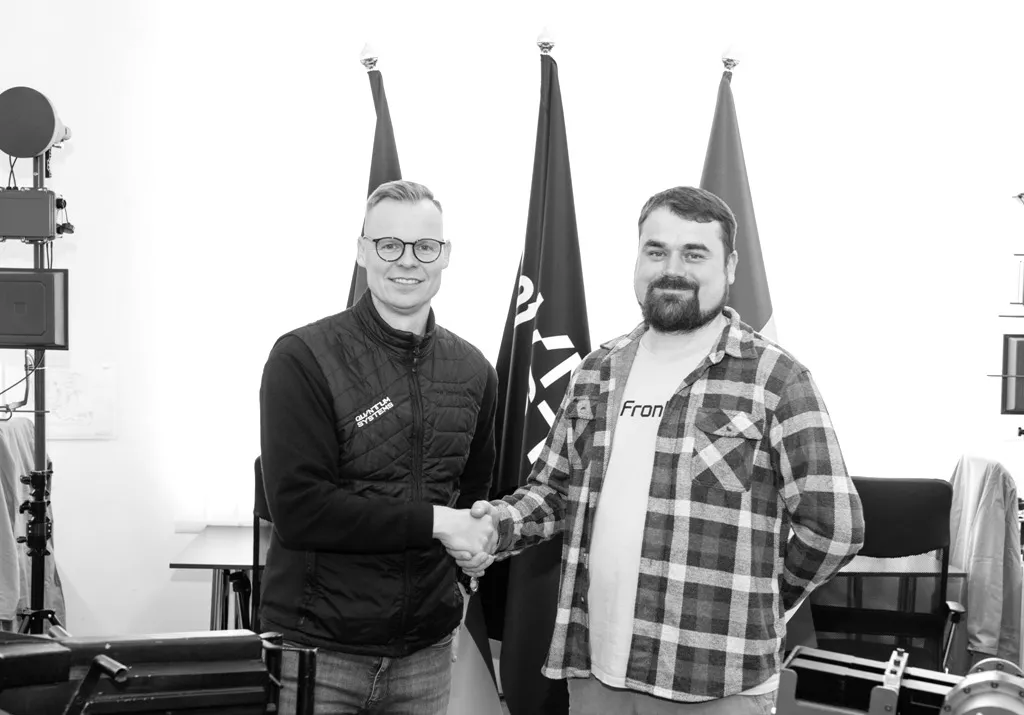
Florian Seibel, co-CEO of Quantum Systems with Frontline CEO Yevhenii Tretiak

Florian Seibel, co-CEO of Quantum Systems with Frontline CEO Yevhenii Tretiak

Share on Linkedin

Startup alliances could be Europe’s secret weapon in its bid to bolster defences in a new era of warfare. And this is why Germany-based dronemaker Quantum Systems has made a strategic investment in Ukrainian defence robotics company Frontline.

You Might Also Like

Hermeus logs first supersonic flight for the uncrewed Quarterhorse Mk 2.1 jet

Understanding China’s cyberthreat to Taiwan’s infrastructure

Orbital Industries, an “AlphaFold” for materials science, raises $50M

The news comes just a couple of months after Quantum Systems raised €160 million from a slew of high-profile investors, including Airbus and Balderton, making it one of just a handful of defence-tech Unicorns in Europe.

Founded in 2015, Quantum Systems specialises in unmanned aerial systems (UAS), with a focus on advanced multi-sensor drones for both the defence and commercial sectors. The company also develops its own AI-infused software which transforms aerial data into actionable insights for security, defence, public safety and industrial applications.

Frontline, for its part, is a two-year-old company specialising in unmanned aerial and ground systems designed for reconnaissance, combat, and electronic warfare environments. Its products, which include the “Linza” bomber and “Zoom” reconnaissance drones, have been certified to NATO’s standards and are already being used by more than 40 military units.

Reconnaissance “Zoom” drone

Frontline only recently closed a $800,000 seed round of funding from Ukrainian and international investors. And now, Quantum Systems has procured 10% of Frontline for an undisclosed sum, with the option to increase this stake by up to 25% over the coming year.

‘Strategic cooperation’

The partnership is designed to foster a “deeper industrial, technical, and strategic cooperation” between the two firms, building on existing synergies while helping Frontline to expand availability of its technologies, including its Zoom and Linza drones.

The deal also formalises a memorandum of understanding signed by the two companies back in April, which in turn builds on their participation in Brave1, an initiative established by the Ukrainian government in 2023 to foster greater collaboration between state, military, and private sector operators working on defence issues.

And already this particular collaboration is bearing fruit. Frontline says it has started integrating a “broader pool of European-sourced components facilitated by Quantum Systems” into its own robotic systems.

“This partnership goes beyond capital – it reinforces our shared vision and accelerates our mission to scale battlefield-proven technologies and turn real frontline feedback into next-generation military robotics,” Frontline CEO Yevhenii Tretiak (pictured above with Quantum Systems’ co-CEO Florian Seibel) said in a statement.

Mykhailo Fedorov, from the Ministry of Digital Transformation of Ukraine, said that he expects the partnership will boost manufacturing capacity in Ukraine and deepen ties with the wider European defence sector. But he also positions such tie-ups as an effective way for global allies to fast-track frontline testing in Ukraine.

“Ukraine’s defence tech ecosystem enables international partners to operate at a high tempo, developing systems, testing them directly on the battlefield, and rapidly implementing changes based on feedback from frontline troops,” Fedorov wrote on social media.

Strategic investments are playing a sizeable role in Quantum Systems’ growth, a trajectory which saw its revenue increase 100% year-on-year to €115 million in 2024. This has included snapping up Germany-based copter drone company AirRobot, which catapulted Quantum Systems to tier-1 supplier status with the U.K. Ministry of Defence. Elsewhere, Quantum Systems also bought the U.K. arm of Nordic Unmanned, a provider of high-end drone products and services.

Aside from Quantum Systems, other European defence tech startups to attain unicorn status include Helsing, a Germany-based military drone and AI software maker which hit a $12 billion valuation back in June. And Portugal-based dronemaker Tekever raised an undisclosed sum back in May as part of a £400 million investment in the U.K., helping it to surpass a £1 billion valuation.

Tags: FrontlineMykhailo FedorovQuantum SystemsUkraine
Previous Post

From Asimov to Azhnyuk

Next Post

France’s Defence Innovation Agency has built a one-stop shop to tap startups

Paul Sawers

Paul Sawers

A seasoned technology journalist, most recently Senior Writer at TechCrunch where his work centered on European startups with a distinctly enterprise flavour. At Resilience Media, Paul focuses substantively on the worlds of open source and infrastructure, looking at technology that helps people and society live outside the sticky ecosystems of Big Tech.

Related News

Hermeus logs first supersonic flight for the uncrewed Quarterhorse Mk 2.1 jet

Hermeus logs first supersonic flight for the uncrewed Quarterhorse Mk 2.1 jet

byJohn Biggs
May 29, 2026

Atlanta-based Hermeus announced that its Quarterhorse Mk 2.1 experimental aircraft has completed its first supersonic flight, reaching Mach 1.21 during...

city building during daytime

Understanding China’s cyberthreat to Taiwan’s infrastructure

byPaddy Stephens
May 29, 2026

Discussions about Taiwan’s security often focus on the military domain, but in any crisis, the resilience of Taiwan’s critical infrastructure...

a computer chip with the letter a on top of it

Orbital Industries, an “AlphaFold” for materials science, raises $50M

byIngrid Lunden
May 28, 2026

A startup called Orbital Industries believes it can make meaningful, less resource intensive, breakthroughs in materials science using AI to...

text

The defence tech boom is creating a cybersecurity industry for machines

byCarly Page
May 28, 2026

The defence tech boom is quietly spawning an entirely new category of cybersecurity startup, one less concerned with phishing emails...

UK’s intelligence chief eyes Russia and China as the major cyberthreats of our time

UK’s intelligence chief eyes Russia and China as the major cyberthreats of our time

byIngrid Lunden
May 27, 2026

While Russia continues its assault on Ukraine, it’s also developed an aggressive posture on the frontlines of a different war:...

Quaze deal gives Red Cat wireless power for drones and robots

Quaze deal gives Red Cat wireless power for drones and robots

byJohn Biggs
May 27, 2026

Red Cat Holdings has acquired Québec-based Quaze Technologies, adding wireless charging capability to its growing portfolio of autonomous systems. The...

New cameras from Odd Systems are making drones faster, smarter, and more accurate

New cameras from Odd Systems are making drones faster, smarter, and more accurate

byJohn Biggs
May 27, 2026

https://youtu.be/-uqLiaA65Pk   Ukrainian defence startup Odd Systems is building a line of mission-specific camera systems designed for drones operating in...

turned on monitor displaying programming language

RevEng.AI lands $15M to defend against the unintended risks of AI

byCarly Pageand1 others
May 27, 2026

Organisations are ramping up their AI adoption, with more than two-thirds of respondents in a McKinsey survey noting pilots or...

Load More
Next Post
France’s Defence Innovation Agency has built a one-stop shop to tap startups

France’s Defence Innovation Agency has built a one-stop shop to tap startups

Brussels Goes Big: €130B for Defence, Space, and Strategic Muscle

Brussels Goes Big: €130B for Defence, Space, and Strategic Muscle

Most viewed

InVeris announces fats Drone, an integrated, multi-party drone flight simulator

Uforce raises $50M at a $1B+ valuation to build defence tech for Ukraine

Auterion, the drone software startup, eyes raising $200M at a $1.2B+ valuation

Palantir and Ukraine’s Brave1 have built a new AI “Dataroom”

Twentyfour Industries emerges from stealth with $11.8M for mass-produced drones

Senai exits stealth to help governments harness online video intelligence

Resilience Media is an independent publication covering the future of defence, security, and resilience. Our reporting focuses on emerging technologies, strategic threats, and the growing role of startups and investors in the defence of democracy.

  • About
  • News
  • Resilence Conference
    • Resilience Conference Copenhagen 2026
    • Resilience Conference Warsaw 2026
    • Resilience Conference 2026
  • Guest Posts
  • Subscribe
  • Privacy Policy
  • Terms & Conditions
  • Mission Statement & Code of Practice
  • Press

© 2026 Resilience Media

No Result
View All Result
  • Home
  • About
  • Subscribe
  • Events
  • Guest Posts
  • Interview
  • News
  • Resilience Conference London 2026
  • Resilience Conference Copenhagen 2026
  • Resilience Conference Warsaw 2026

© 2026 Resilience Media

This website uses cookies. By continuing to use this website you are giving consent to cookies being used. Visit our Privacy and Cookie Policy.