

Lithuania declares Security Emergency as ICEYE, Nu Quantum lead defence tech funding surge
Issue 51: Plus Helsing and Kongsberg announce a partnership, Anaphite makes a cleaner battery, Orqa increases its manufacturing capacity, the UK makes its seabed safer, and more
Good afternoon from the team at Resilience Media
As predicted, December has certainly not been a slow news month. This week, UK-based Nu Quantum announced a $60M Series A round (excerpted below in our Funding Announcement section) and ICEYE raised a monster $200M Series E that saw the addition of Jeannette zü Furstenberg to its board. Helsing added space to its multi-domain portfolio with a partnership with Kongsberg. And the Lithuanian Government declared a state of emergency over the balloon and drone incursions into its airspace.
Lithuania is in a unique position with its major airport 32km (20mi) from the sizeable border it shares with Belarus and he country has also been vocal about its commitment to defending itself, with Soviet occupation in living memory. Both make the territory a target for ‘grey war’ tactics. I had the honour of attending the Baltic Armed Forces Reception two weeks ago and everyone in attendance from Estonia, Latvia, and Lithuania could recall Soviet tanks in their communities. By declaring these incursions a national security risk, the government is able to be more nimble in case the balloon and drone payload changes from cigarettes to something more nefarious. We are tracking this development in Lithuania from both a geopolitical and a startup perspective. If you’re working on a technology that could be part of Lithuania’s tech stack, let Julia Gifford, Resilience Media reporter know. We’d love to cover you.
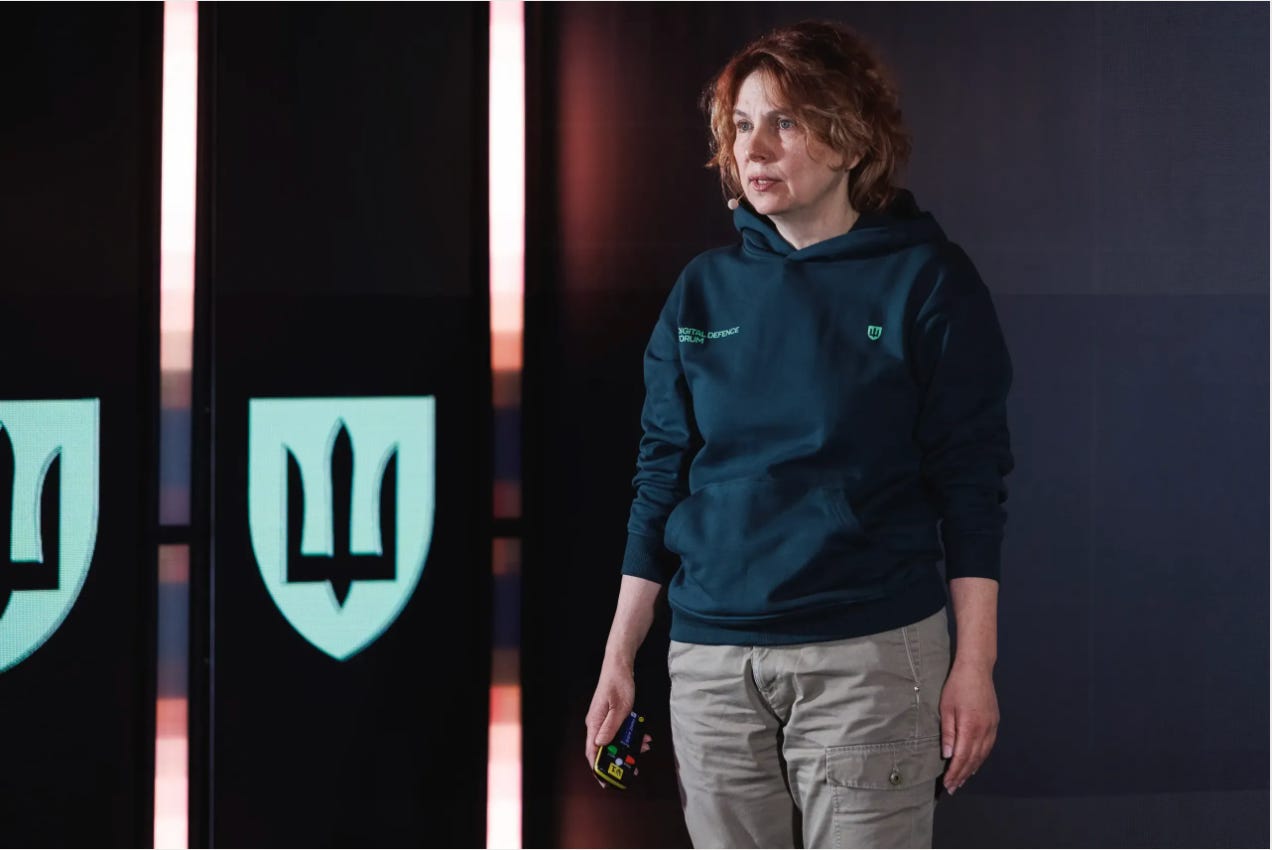
Resilience Media correspondent, Thomas Macaulay recently sat down with Ukraine’s Deputy Minister of Defence for Digitalisation, Oksana Ferchuk (pictured above) to talk about Ukraine’s plans to seed 7,000+ techies across its military. “We have thousands of IT-related personnel already in the Armed Forces, but they are occupying other, different positions,” Ferchuk said. “They are soldiers, not IT specialists, but they perform an IT role. We would like to make this institutional change — to have those positions officially and to have skilled people in such positions.” Something a lot of our governments can learn from. Read more in our Dispatches from Ukraine section below.
Elsewhere on Resilience Media:
Anaphite targets cleaner battery production for with new UK government funding
No Anduril is an island: US defence unicorn teams with GKN Aerospace on the Isle of Wight
UK launches undersea surveillance programme to counter growing Russian threat
Got a tip, funding announcement, or news? Send it our way. I’ll be back in your inboxes next week.
-Leslie Hitchcock, co-founder and Publisher, Resilience Media

Our fundraiser with Help99 to help rebuild a Ukrainian frontline air defence lab is still live. ICYMI, an active-duty Ukrainian officer named Oleksandr spoke at Resilience Conference 2025 and shared that his unit, The Interceptor Battery of The Air Defence Division of the 3rd Assault Brigade, lost its R&D lab to a Russian bomb. This unit defends a 180km strip of Ukraine’s border against hundreds of drone attacks every day and night, and every day and night they save the lives of Ukrainian civilians and soldiers. We launched a fundraiser two weeks ago to help rebuild it.
Thank you to those of you who have donated already: we are within €10K of reaching our goal of €35,000. If you cannot donate, we ask that you share the campaign with your network.

Mykhailo Fedorov, Ukraine’s First Deputy Prime Minister and Minister of Digital Transformation, announced on Monday a significant step forward in how the country’s military will tap technology in its war with Russia. More than 7,000 “digital officers” – defence technologists – will be deployed to work “across all commands and branches,” Fedorov said in a short note on LinkedIn.
Fedorov’s post outlined the five areas these digital officers will oversee. They will implement systems within units, collect and provide feedback on how tech is being used, identify operational needs and work as clients and solution architects to meet those needs (which means working with the tech providers to buy and tailor solutions), and “foster an IT culture within the armed forces.”
The plan is a progression of the country’s Chief Digital Transformation Officer (CDTO) programme, which has seen tech specialists deployed across national and local government departments and community groups.
Ukraine’s military has become a global beacon for how tech like autonomous drones can change the game and help smaller groups of soldiers gain an advantage over bigger ones on the battlefield.
But a lot of that, especially in its earlier incarnations, emerged out of organic necessity, combined with the population’s technological and entrepreneurial nous, rather than concerted planning from the top. Seeding digital officers across the military could help Ukraine scale that tech advantage to all battalions.
“This new structure will significantly accelerate [the] army’s digitalisation,” Fedorov said.
Defence Minister Denys Shmyhal described the officers as “an IT vertical for the Armed Forces” who would “cultivate a digital culture” in every unit. “Such people are already working on the ground, and we will unite them into a single network,” he added. Keep reading here.
Cambridge-based Nu Quantum — which develops photonic technology used in quantum computing architectures — has secured a landmark $60 million in Series A funding. The startup said this is the largest round ever raised by a “pure-play” quantum networking company, and the biggest quantum Series A in the UK to date.
National Grid Partners, the investment arm of the National Grid, led the round, with participation from new investors Gresham House Ventures and Morpheus Ventures, and existing investors including Amadeus Capital Partners, IQ Capital, Ahren Capital, Cambridge Enterprise Ventures, East Innovate, NSSIF, and Sumitomo (Presidio Ventures). The round was first reported to be in the works by The Telegraph earlier this year.
Nu Quantum said it will be using the funding to continue building its distributed quantum computing platform, which is based on interconnecting quantum processors working in a unified, scalable fabric. As with a lot of the technology being developed for quantum computing, Nu Quantum’s focus is on functionality that will be necessary in a future where quantum computing will have made a breakthrough with error correction and moved beyond labs and into wider environments and broader use cases. Nu Quantum’s architecture, which it terms the “Entanglement Fabric”, could form the backbone of future quantum data centres, it says, enabling fault-tolerant machines with performance unreachable by any single quantum processor.
