

EU needs control, not sovereignty; Inside the drone revolution; and donate to our Ukrainian brigade fundraiser
Issue 50: Plus Rheinmetall partners with Varjo, PowerUp raises €10m, Terma buys OSL, NATO and Ukraine team up to fast track battlefield innovation, and more
Good afternoon from the team at Resilience Media
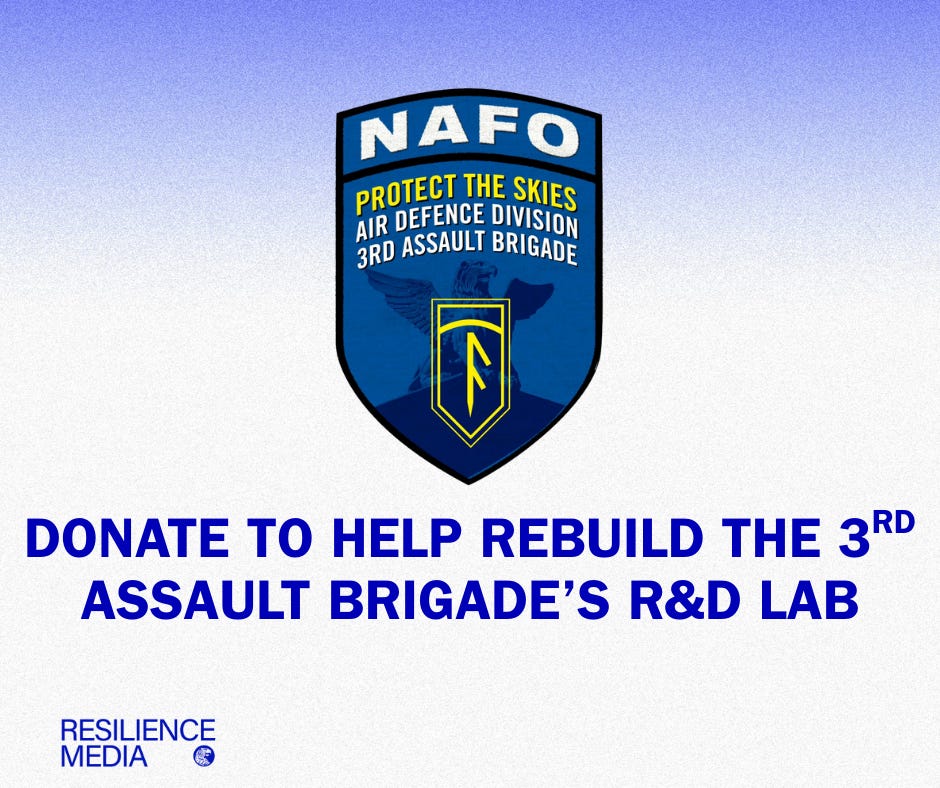
Yesterday we launched a fundraiser with Help99 to help rebuild a Ukrainian frontline air defence lab. An active-duty Ukrainian officer named Oleksandr spoke at Resilience Conference 2025 and shared that his unit, The Interceptor Battery of The Air Defence Division of the 3rd Assault Brigade, lost its R&D lab to a Russian bomb. This unit defends a 180km strip of Ukraine’s border against hundreds of drone attacks every day and night, and every day and night they save the lives of Ukrainian civilians and soldiers.
Oleks gave of his time and expertise while he was in the UK. He mentored at the European Defense Tech Hub Hackathon in London, spoke at Resilience Conference, attended Future Forces Demo Day, and spent time with highly-funded drone technology startups providing feedback on their products — all for free. It is only right that we acknowledge what he has done for NATO and give back to him and his unit in the way that we can. And a special thank you to Snake Island Institute who made Oleksandr’s visit possible.
Thank you to those of you who have donated already. We will keep the fundraiser open until it reaches its 35,000€ goal, and after launch it is 34% there. If you cannot donate, we ask that you share the campaign with your network. As Tobias said yesterday, the money is nice, but it is also important to let our Ukrainian friends and colleagues know we’re thinking of them during a really difficult time.
This week we published several guest posts that I thought you might like to catch up on over the weekend. In extended excerpts below are opinions from Srdjan Kovacevich, CEO and Co-founder, Orqa FPV; Nicola Sinclair, Partner, Twin Track Ventures; and Toby Wilmington, CEO, Periphery. Do you have an idea for a guest post? Send it our way.
John Biggs, Editor at Large dug into several reports, one by the UK House of Commons called “The UK contribution to European Security,” and the other by Dealroom and Danske Bank on dual-use investing in the Nordics. More to come on those.
Elsewhere on Resilience Media:
Dual-use hydrogen firm PowerUp tops up with another €10M in the tank
Rheinmetall and VR-maker Varjo team up to build low-cost, easy-to-deploy training simulators
Terma buys UK-based OSL to sharpen European counter-drone coverage
NATO and Ukraine launch joint initiative to fast-track battlefield innovation
Got a tip, funding announcement, or news? We are all ears. And with that, I’ll see you again next week.
-Leslie Hitchcock, co-founder and Publisher, Resilience Media


Nationalism is deepening Europe’s fragmentation. Today, defence ministries buy tech like Apple customers: powerful hardware, closed ecosystem, someone else’s rules. A consumer in a walled garden.
But to be even more accurate, this analogy should describe a user that has never thrown anything away. Missions planned on an Apple I; logistics put through a Lisa; a Newton personal digital assistant that is ‘mission critical’; and iPod Nanos on the front line. Because little is ever retired, any new system needs to mesh into this multi-decade tangle of architectures that were never supposed to work together.
I can tell you first-hand just how many hacks and bodge jobs exist in defence to allow users to climb over, around and under those walls every single day. But usually, the fix isn’t a piece of software: it’s a person. Our digital systems are glued together with expensive, hard to train, fragile humans.
At some point you stop asking how we can make all the old layers talk to each other and start thinking about what the architecture could look like if it were built for modern missions. Distributed sensing, autonomy at scale, resilient communications – all in real time.
And when you imagine what this could be if it were started from a blank sheet of paper, one word comes up over, and over, again.
Sovereignty.
People have spent a lot of time trying to define this word, or at least capture the subtly different ways that tech sovereignty has been unpacked in numerous sources. But despite this significant body of work, there remains no agreed definition. Keep reading here.

Reports from the Ukraine front line make clear the tactics and equipment deployed by both sides are unlike those used in any previous major conflict. What’s less obvious is the exact nature of the transformation: what’s driving it, where it’ll go next, and - crucially - what lessons we can learn.
The war in Ukraine has dramatically transformed modern warfare, and it would not be an overstatement to compare it with the major revolutionary advancements in military history.
At the heart of this transformation is a deep integration of unmanned aerial systems (UAS) which provides a step change in cost-effectiveness, intelligence gathering capabilities, precision strikes, and force multiplication, all while reducing human risk.
An army that has embraced these capabilities will have a decisive edge over one that has not, making the outcome of a clash between the two almost inevitable.
During the war in Ukraine, both Ukrainian and Russian militaries have undergone profound transformations adopting unmanned systems, fundamentally altering the nature of their military operations.
Both sides significantly changed the types of unmanned assets they deploy and the way they employ them. The paradigm has shifted from having a handful of expensive unmanned platforms operated at higher echelons of command (typically for reconnaissance or strategic strike), to deploying an overwhelming mass of attritable UAS operated at the battalion level or below, enabling persistent presence, precision effects, rapid reaction, and tactical autonomy.
The impact of this transformation on the Ukrainian battlefield is undeniable: a staggering 78% of Russian equipment losses over the last three years are attributed to drone strikes.
There are five main reasons why this transformation had such a dramatic impact.
More from Srdjan Kovacevich here.


Modern conflict is no longer confined to war zones, with technology advances enabling adversaries to reach far beyond border regions. This is true not just in kinetic warfare, with drones and missiles capable of coordinating strikes thousands of kilometres apart. It’s equally true in digital warfare, where nation states are among the most malicious actors when it comes to disrupting and disabling infrastructure.
Our entire economy and our society — from finance and business to healthcare and transportation — rely on interconnected infrastructure systems. This makes the security of that critical infrastructure a concern of national security proportions.
Put that way, you may understand the urgency, but the reality is more nascent. While the defence industry has become comfortable talking in terms of drones and distance strikes, it is yet to truly embrace the concept of digital defence.
However, as the threat landscape continues to evolve, it is clear that cybersecurity is no longer just the purview or concern of the tech sector; it needs to be a priority for the defence sector, too.